
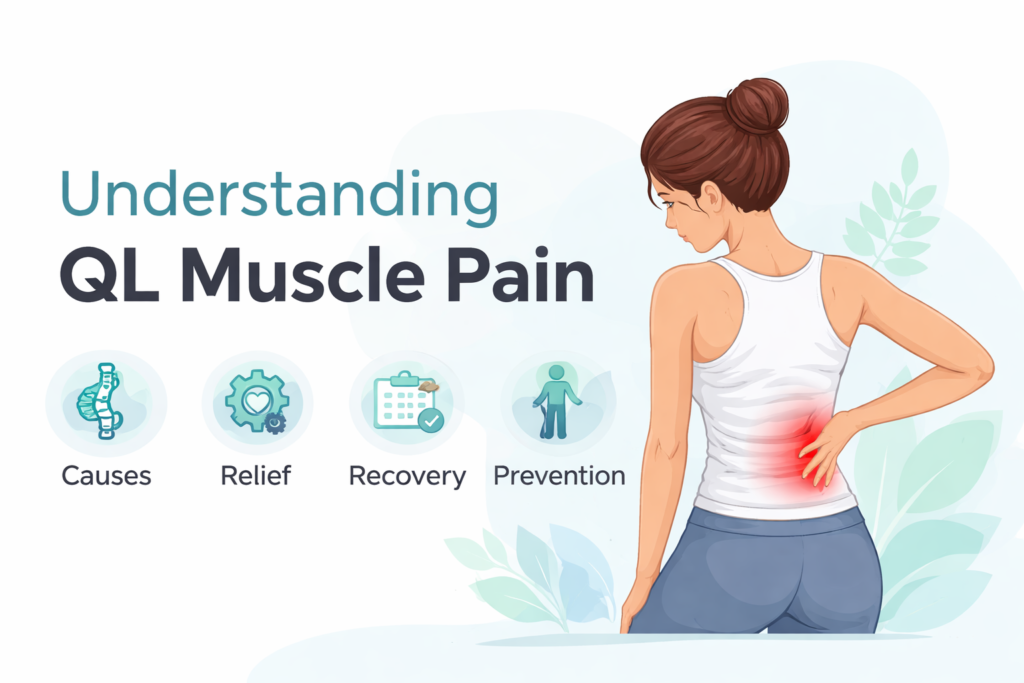
One of the most common things I hear from people dealing with ongoing lower back discomfort is this: “My reports are normal, but the pain is still there.” This situation is frustrating, confusing, and understandably worrying. When scans and tests do not show a clear structural problem, many people are left feeling stuck, as if their pain has no clear explanation. In my experience, this is often where deep muscular pain, especially involving the quadratus lumborum (QL) muscle, is overlooked.
Pain that sits on one side of the lower back, especially pain felt just above the hip or along the waist, is frequently misunderstood. It is often labeled as generic lower back pain, posture-related discomfort, or even dismissed as something temporary. However, one-sided lower back muscle pain behaves differently from spinal or disc-related pain. It tends to feel deeper, more gripping, and harder to stretch out. Many people describe it as a constant tightness or an ache that never fully settles, even when they rest.
This is where the QL muscle quietly becomes the main source of discomfort. The quadratus lumborum is a deep stabilizing muscle that works constantly to keep the body upright and balanced. Because it sits beneath more obvious muscles and does not usually cause sharp pain, it often escapes attention. Instead, it gradually becomes overworked, tense, and guarded, leading to persistent lower back muscle tightness that does not show up clearly on imaging.
I see this pattern repeatedly. People come in convinced something serious has been missed because the pain keeps returning. In reality, the issue is often muscular rather than structural. The body is signaling overload, imbalance, or chronic tension in a muscle that rarely gets the care it needs. Once this is understood, the situation becomes far less alarming and far more manageable.
In this guide, I want to help you understand what QL muscle pain really is, why it behaves the way it does, and how it differs from other causes of lower back discomfort. More importantly, I want to show you practical, natural ways to support this muscle so it can finally relax. By the end, you should feel clearer about what your body is experiencing and more confident about the steps you can take to ease the discomfort and prevent it from becoming a recurring problem.
The QL Muscle Explained in Simple, Practical Terms
The quadratus lumborum, often shortened to the QL muscle, is not a muscle most people are familiar with, yet it plays a major role in how the lower back feels day to day. One reason QL muscle pain is so confusing is because this muscle is deep, quiet, and constantly working in the background. You don’t see it flexing, and you don’t usually feel it working—until it becomes tense or irritated.
The QL muscle sits deep in the lower back, running vertically between the lower ribs and the top of the pelvis on each side of the spine. Because of this location, pain from the quadratus lumborum is often felt above the hip, along the side of the lower back, or as a deep ache that seems to sit inside the body rather than on the surface. This is very different from superficial muscle soreness, which is easier to pinpoint and easier to stretch.
Another reason this muscle causes confusion is that it cannot be easily stretched or “worked out” in the way many people expect. Traditional lower back stretches often miss the QL entirely or place too much force on surrounding structures. Similarly, general core exercises do not always reach this muscle effectively. As a result, people try harder and harder to stretch or strengthen without real relief, which can actually increase muscle guarding rather than reduce it.
Functionally, the QL acts as a connector and stabilizer. It links the rib cage, spine, and pelvis, helping keep the torso upright and balanced. Every time you stand, walk, sit, bend slightly, or shift weight from one side to the other, the QL is involved. It also helps control side bending and stabilizes the lower spine during everyday movements that seem effortless.
Perhaps most importantly, the QL stays active even when you think you are resting. Sitting upright, driving, standing still, or even lying in certain sleeping positions all require the QL to provide low-level support. Because it rarely gets a true break, tension can build gradually. Over time, this constant activity can lead to deep lower back muscle tightness that feels stubborn and slow to resolve.
Understanding where the QL muscle is and how it functions is an important step in making sense of one-sided lower back pain. Once you realize that this deep muscle is always working—and rarely releasing—it becomes much easier to understand why discomfort develops and why a different, more supportive approach is often needed to help it relax.
How QL Muscle Pain Develops Over Time (Not Overnight)
QL muscle pain rarely appears suddenly. In most cases, it develops gradually, building up over weeks or even months. This slow progression is one of the reasons it is so often ignored or misinterpreted. People adapt to mild discomfort, adjust their posture without realizing it, and only seek answers when the pain becomes persistent and disruptive.
One of the biggest contributors is prolonged sitting and postural loading. Sitting for long hours, especially with poor back support, places continuous demand on the quadratus lumborum. The muscle works quietly to keep the torso upright and prevent collapse to one side. Over time, this constant low-level contraction leads to fatigue and tightness. Unlike muscles that move dynamically, the QL is forced to stabilize for long periods without fully relaxing.
Uneven weight-bearing and daily asymmetry add another layer of strain. Carrying a bag on one shoulder, favoring one leg while standing, crossing the same leg repeatedly, or consistently leaning to one side all train the QL on one side to work harder than the other. This imbalance often explains why the pain is felt more strongly on one side of the lower back rather than centrally.
Stress-related muscle guarding plays a significant role as well. Emotional and mental stress does not stay confined to the mind. It often shows up physically as increased muscle tension, particularly in deep stabilizing muscles like the QL. When the nervous system stays in a heightened state, the muscle remains partially contracted, making it difficult to fully relax even during rest.
Sleep can also contribute in subtle ways. Certain sleep positions, especially side sleeping without proper support or mattresses that do not support the spine evenly, can lock the QL in a shortened or loaded position overnight. Instead of recovering, the muscle wakes up tight and irritable, leading to morning stiffness and discomfort that lingers throughout the day.
Because all of these factors act slowly, QL muscle pain often builds quietly and becomes persistent. There may not be a single injury or obvious trigger to point to. Instead, the discomfort gradually becomes part of daily life, making it harder to recognize the underlying cause. Understanding this slow development is important, because it shifts the focus away from quick fixes and toward consistent, supportive care that allows the muscle to finally release and recover.
How QL Muscle Pain Feels (And Why People Describe It Differently)
One of the challenges with QL muscle pain is that people describe it in many different ways. Some call it a dull ache, others describe a deep gripping sensation, and some struggle to find the right words altogether. This variation is not because the pain is imagined or inconsistent, but because the quadratus lumborum is a deep muscle, and deep muscle pain behaves differently from surface muscle soreness.
Many people experience deep, gripping lower back muscle pain that feels as though it is coming from inside the body rather than from the skin or outer muscles. It may not be sharply painful, but it is persistent and difficult to ignore. This type of discomfort often creates a sense of tightness that never fully lets go, even with rest.
A very common feature is one-sided pain above the hip or along the waist. Instead of feeling centered in the spine, the discomfort tends to sit slightly to the left or right, following the natural path of the QL muscle. This is one of the reasons people often suspect hip problems or kidney-related issues before considering a muscular cause.
Another hallmark of QL pain is an ache that worsens after sitting or lying down. Long periods of inactivity allow tension to build, and when movement resumes, the muscle feels stiff and resistant. This explains why standing up after sitting or getting out of bed can feel particularly uncomfortable.
Stiffness when standing up or turning in bed is another common complaint. Simple movements such as rolling over at night, bending slightly to one side, or shifting position can trigger a pulling or catching sensation in the lower back. These movements involve subtle activation of the QL, which becomes noticeable when the muscle is tight or fatigued.
What sets QL muscle pain apart from surface muscle soreness is its depth and persistence. Surface muscles tend to feel tender to touch and respond quickly to stretching or massage. In contrast, QL pain feels harder to reach and slower to change. This difference often leads people to believe something more serious is wrong, when in fact the issue lies in a deep stabilizing muscle that needs a different kind of support to relax.
Recognizing these patterns helps reduce confusion and unnecessary worry. Once you understand how QL muscle pain typically feels, it becomes easier to identify and manage it with approaches that address the muscle’s unique role and behavior.
Why QL Pain Often Feels Worse at Night or During Rest
Many people find it confusing—and frustrating—that their QL muscle pain feels more noticeable at night or during periods of rest. During the day, movement and distractions often keep discomfort in the background. Once the body slows down, however, the pain seems to come forward. This pattern is very common with deep muscles like the quadratus lumborum and does not mean the condition is getting worse.
One important factor is nervous system downshifting and pain awareness. During the day, the nervous system stays alert and focused on tasks, which can dampen pain signals. At night, as the body transitions into rest, this protective distraction fades. Sensations that were present all along become easier to notice, making discomfort feel more intense even though the muscle itself has not changed.
Muscle fatigue also finally becomes noticeable once activity stops. The QL works continuously throughout the day to stabilize the torso during sitting, standing, and walking. When movement slows, the accumulated fatigue surfaces as a deep ache or tightness. This is similar to how tired legs feel heavy at the end of a long day, except the sensation is deeper and less obvious.
Reduced movement and circulation play a role as well. Gentle movement helps maintain blood flow and keeps muscles from stiffening. When you lie down or remain still for extended periods, circulation decreases slightly, and the QL may remain in a shortened or guarded position. This can increase stiffness and make turning in bed or changing positions uncomfortable.
Night-time discomfort is particularly common with deep stabilizing muscles because they do not fully switch off during rest. Even when lying down, the QL continues to provide subtle support to maintain spinal alignment. If the muscle is already tight or overworked, this ongoing demand can prevent full relaxation and lead to lingering discomfort that disrupts sleep.
Understanding why QL pain behaves this way can be reassuring. Night-time or rest-related discomfort does not automatically indicate damage or worsening injury. More often, it is a signal that the muscle needs intentional support to relax and recover, especially during the hours when the body is meant to restore itself.
The Three Functional States of QL Dysfunction
QL muscle pain does not look or feel the same in everyone because the muscle can exist in different functional states. Understanding which state the quadratus lumborum is in helps explain why symptoms vary and why certain approaches work better than others. Most people move through these stages gradually rather than suddenly.
A Constantly Tight QL
In this state, the QL carries low-level tension that never fully releases. The muscle remains partially contracted throughout the day, even during rest. People often describe this as a background ache, stiffness, or a sense that one side of the lower back always feels “on” or guarded.
This type of tightness usually develops from prolonged sitting, habitual postures, or ongoing stress. Because the muscle is not acutely injured, the pain may feel manageable at first. Over time, however, constant tension limits normal movement and increases fatigue, making the muscle more sensitive to everyday activities.
An Overworked or Irritated QL
When a tight QL continues to work without adequate recovery, it can become overworked and irritated. At this stage, trigger points often develop within the muscle. These are sensitive spots that can refer pain to nearby areas, such as the hip, flank, or deeper into the lower back.
People in this stage may notice sharper discomfort with certain movements or positions, as well as pain that seems to spread rather than stay in one precise spot. Trigger point–related QL pain often feels unpredictable, which can add to anxiety and confusion about the source of discomfort.
A Strained QL Muscle
A strained QL muscle represents a more advanced stage of dysfunction. Strain usually occurs when an already tight or fatigued muscle is asked to handle a sudden load, such as lifting, twisting, or an awkward movement. Unlike general tightness, strain produces more noticeable pain and may limit movement.
The important thing to understand is that, even at this stage, healing usually responds well to proper care. Strains take longer to settle because deep muscles recover slowly, but with reduced overload, gentle movement, and consistent support, improvement is the norm rather than the exception. Recognizing the difference between tightness and strain helps set realistic expectations and prevents unnecessary fear.
Understanding these functional states allows you to approach QL muscle pain with clarity rather than guesswork. Instead of pushing harder or ignoring symptoms, you can choose strategies that match what the muscle actually needs at each stage of recovery.
Daily Life with QL Muscle Pain
QL muscle pain often becomes most noticeable not during exercise, but during ordinary moments of daily life. This is where many people start to feel discouraged, because the discomfort interferes with tasks that should feel effortless. When readers recognize their own experiences in these situations, it helps them feel understood and reassured that their pain has a real, explainable cause.
Sitting at a desk or working on a laptop is one of the most common triggers. Prolonged sitting places continuous demand on the quadratus lumborum to keep the torso upright and balanced. Subtle leaning, uneven chair support, or working on a laptop off to one side can cause one QL muscle to work harder than the other. Over time, this leads to deep lower back muscle tightness that feels worse the longer you sit, especially when you stand up afterward.
Driving for long periods can create similar strain. The seated position, limited movement, and slight twisting involved in steering keep the QL engaged without relief. Many people notice that after a long drive, one side of their lower back feels stiff or achy, making it uncomfortable to get out of the car or straighten up fully.
Standing still for extended periods can be just as challenging. While movement allows muscles to alternate between contraction and relaxation, standing in one position forces the QL to stabilize continuously. This is especially noticeable for people who stand for work or spend long periods waiting or observing. The muscle becomes fatigued, leading to a deep, dull ache that can linger even after sitting down.
Sleeping on one side is another situation where QL discomfort often appears. Side sleeping without proper support can place the lower back in a slightly bent position, shortening the QL on one side throughout the night. Instead of recovering, the muscle stays loaded for hours, which explains why many people wake up with one-sided lower back stiffness or pain that improves only after moving around.
On stressful or physically demanding days, QL muscle pain often feels more intense. Stress increases overall muscle tension, and the QL, as a deep stabilizing muscle, tends to respond by tightening further. Physical fatigue combined with mental stress can leave the muscle feeling heavy, tight, and resistant to relaxation by the end of the day.
These daily-life triggers explain why QL muscle pain can feel relentless. It is not caused by a single activity, but by repeated, familiar patterns that add up over time. Recognizing these moments helps shift the focus away from self-blame and toward practical changes and supportive care that allow the muscle to finally release.
Why Forceful Stretching and Aggressive Exercise Often Backfire
When QL muscle pain does not improve quickly, many people respond by trying to stretch harder or exercise more aggressively. This reaction is understandable, but with deep stabilizing muscles like the quadratus lumborum, it often leads to the opposite of what is intended. Instead of releasing, the muscle tightens further.
One reason for this is that deep stabilizing muscles resist force. The QL’s primary job is to protect the spine and maintain stability. When it senses sudden or excessive stretching, it interprets this as a threat rather than relief. In response, the muscle increases tension to guard the area. This protective reaction makes the muscle feel even tighter and more painful after aggressive stretching.
It is also important to understand the difference between lengthening a muscle and relaxing a muscle. Lengthening refers to physically stretching muscle fibers, while relaxation involves reducing the nervous system signals that keep the muscle contracted. Deep muscles like the QL are often tight because they are overactive, not because they are short. In these cases, forcing length without first encouraging relaxation rarely helps.
This explains why many people feel worse after “stretching harder.” Instead of easing discomfort, aggressive stretching can increase soreness, trigger guarding, and create a sense that the muscle is more irritated than before. The same principle applies to high-intensity exercise that loads the lower back without addressing underlying tension. The muscle is already working too hard; asking it to do more only prolongs the problem.
With QL muscle pain, gentler approaches tend to be far more effective. Strategies that focus on calming the muscle, improving circulation, and encouraging gradual release allow the QL to feel safe enough to relax. Once this happens, movement becomes easier and more comfortable without the cycle of flare-ups that forceful methods often create.
What the QL Muscle Actually Needs to Settle
Once you understand how the QL muscle behaves, it becomes clear that this muscle does not respond well to force. What it needs instead is a shift from constant protection to permission to relax. This change does not happen instantly, but it happens reliably when the right conditions are created.
The first requirement is reduced guarding. Guarding is the muscle’s protective response to stress, overload, or perceived threat. As long as the QL feels it must protect the spine, it will remain tense. Reducing guarding means easing physical strain, improving posture, and calming the nervous system so the muscle no longer feels the need to stay “on” all the time.
Gentle release is far more effective than aggressive techniques. Light, sustained pressure, slow movement, and calm breathing help signal safety to the muscle. When release is gradual, the QL begins to soften rather than resist. This is why subtle approaches often work better than intense stretching or forceful massage.
Warmth and circulation play an important role as well. Warmth increases blood flow and encourages muscle fibers to relax, especially in deep muscles that are slow to release. Improved circulation helps clear metabolic waste and reduces the heavy, fatigued sensation that often accompanies QL pain. Many people notice that warmth makes the area feel more responsive and less guarded.
Another key element is consistency rather than intensity. The QL responds best to small, repeated signals of support rather than occasional, intense interventions. A muscle that has been tight for months will not change after one session. Regular, gentle care allows the muscle to gradually reset without triggering defensive tension.
Finally, the QL needs support for relaxation rather than stimulation. Overworked muscles do not need to be pushed or activated further; they need help letting go. Approaches that encourage calmness—both physically and mentally—create the conditions in which the QL can finally settle. When relaxation becomes part of a daily routine, the muscle is far more likely to release and stay comfortable over time.
Understanding what the QL truly needs shifts the focus away from fighting the pain and toward working with the body. This change in approach is often the turning point where progress finally begins.
Natural Ways to Calm QL Muscle Pain (Foundation Care)
Before introducing any topical or supportive products, it’s important to build a foundation of care that helps the QL muscle feel safe enough to relax. These natural strategies focus on reducing ongoing strain while still allowing the body to move and recover. When used together, they create the right environment for deeper relief.
Activity modification without immobilization is the first step. Completely avoiding movement often backfires, especially with a stabilizing muscle like the quadratus lumborum. Instead of stopping activity altogether, the goal is to reduce or adjust the movements that clearly aggravate pain. Shorter sitting periods, changing positions more frequently, and avoiding sudden twisting or heavy lifting allow the muscle to recover without becoming stiff.
Gentle movement and posture awareness make a noticeable difference over time. Simple actions like standing up regularly, shifting weight evenly, and keeping the rib cage stacked over the pelvis reduce unnecessary load on one side of the lower back. Gentle walking and controlled mobility help maintain circulation and prevent the QL from staying locked in one position for too long.
Light massage and self-release can be very effective when done thoughtfully. Because the QL sits deep, aggressive pressure often causes guarding. Instead, slow, steady contact along the side of the lower back encourages relaxation. Even placing a hand over the area and breathing calmly can help the muscle soften. The intention is to calm the muscle, not to force change.
Choosing between heat and cooling support depends on how the muscle feels. Heat is often more helpful for chronic tightness, stiffness, and night-time discomfort, as it promotes circulation and relaxation. Cooling support can be useful if the area feels irritated after activity. Listening to your body’s response rather than following a rigid rule usually leads to better results.
Finally, creating a daily muscle-care routine is what ties everything together. QL muscle pain rarely improves with one-off efforts. Small, consistent actions—gentle movement, posture awareness, relaxation, and recovery—signal safety to the muscle day after day. This routine approach prepares the body to respond more positively to additional support methods and makes lasting improvement far more likely.
Establishing this foundation sets the stage for deeper, targeted care. Once the QL begins to feel supported rather than challenged, it becomes much more receptive to approaches that help it truly relax.
Why a Topical Approach Works Especially Well for QL Muscle Pain
When it comes to QL muscle pain, a topical approach often makes more sense than people expect, especially once you understand how this muscle behaves. The quadratus lumborum is not inflamed in the way an acute injury might be. Instead, it is usually tight, fatigued, and over-guarded. This distinction matters, because the goal is not to shut pain down forcefully, but to help the muscle relax and reset.
One of the main advantages of topical support is localized relief for deep muscle tension. Even though the QL sits deep within the lower back, the body responds strongly to signals applied at the surface. Gentle massage combined with topical application increases local circulation and provides sensory input that tells the nervous system the area is safe. This can help reduce guarding and encourage the muscle to soften over time. You are working with the muscle rather than trying to override it.
Another important benefit is supporting relaxation without systemic overload. Many people dealing with persistent lower back muscle pain are already tired, stressed, or sensitive to internal interventions. A topical approach avoids placing additional demands on digestion or the nervous system. Instead, it allows you to focus care exactly where it’s needed, while keeping the rest of the body undisturbed. This is particularly helpful for ongoing or night-time discomfort, where gentle support is preferable to anything stimulating.
QL pain also responds very well to nightly routines, which is where topical care fits naturally. Because symptoms often become more noticeable in the evening or during rest, applying support at the end of the day aligns perfectly with the muscle’s needs. Night-time routines signal the body to slow down, and consistent topical application reinforces that message. Over time, this regular pattern helps the QL associate rest with relaxation rather than tension.
A topical approach works best when it is not treated as a quick fix, but as part of a calming ritual. When applied consistently, with gentle touch and intention, it supports the body’s natural recovery processes. For a deep stabilizing muscle like the QL, this steady, localized care is often what finally allows lasting improvement to begin.
Why I Created My Magnesium Cream for Deep Muscle Tension
I created this magnesium cream because, as a doctor, I kept seeing the same pattern repeat itself—people with deep muscle tension that wasn’t responding to forceful treatments, aggressive exercise, or short-term fixes. Muscles like the quadratus lumborum don’t behave like surface muscles, and yet they were often being treated the same way. I wanted a solution that respected how these deep, stabilizing muscles actually work and recover.
QL muscle pain influenced my formulation philosophy more than people might realize. This muscle becomes uncomfortable not because it is weak, but because it is overworked and guarded. It spends most of the day stabilizing the body during sitting, standing, and subtle movements, often without ever fully relaxing. What it needs is not stimulation, but support—something that helps it let go gradually and consistently. That understanding shaped every decision behind this product.
Magnesium stood out because of its well-established role in normal muscle relaxation and function. Overworked muscles often struggle to switch off, and magnesium supports the processes that allow muscles to release after prolonged contraction. When applied topically, magnesium becomes part of a calming routine rather than an internal intervention, which aligns well with the needs of sensitive or fatigued muscles.
I formulated this cream with the intention of making it suitable for regular, long-term use, not just occasional flare-ups. It is meant to be applied gently, with awareness, as part of a daily or evening routine. For deep muscle tension like QL pain, consistency matters far more than intensity. My goal was to create something that people could rely on to support relaxation, comfort, and recovery—without overwhelming the body or masking important signals.
This product reflects how I approach muscle care overall: work with the body, respect its signals, and support it in a way that feels safe and sustainable. When deep muscles like the QL are given the right kind of support, they often respond better than expected.
What’s Inside the Cream and Why Each Ingredient Matters
When I formulate a topical product, I pay close attention not only to what it does for muscles, but also to how it feels on the skin and how well it can be used consistently. Deep muscle tension, like QL muscle pain, often requires regular application, so every ingredient needs to support comfort, safety, and effectiveness over time. This is why the formulation balances muscle support with skin care and stability.
At the core of the cream is magnesium chloride at 25%. Magnesium plays an important role in normal muscle function and relaxation, particularly for muscles that remain overworked or guarded. Using it in a topical form allows it to be incorporated into a calming routine, applied directly to areas of tension, and paired with gentle massage. For deep lower back muscle tightness, this localized approach supports relaxation without overwhelming the body.
To ensure the cream remains comfortable and nourishing on the skin, I included shea butter and cocoa butter. These ingredients help soften and protect the skin, making the cream suitable for repeated use. When a product feels pleasant to apply, people are far more likely to use it consistently, which is essential for supporting muscles that need ongoing care.
Calendula oil, along with argan oil and olive oil, was chosen for their soothing and conditioning properties. These plant-based oils support skin comfort and help reduce the dryness or sensitivity that can sometimes occur with frequent topical application. Their role is not to stimulate the area, but to create a gentle, supportive base that allows the cream to be used daily without irritation.
Glycerine and vitamin E contribute to maintaining the skin’s natural barrier. Glycerine helps retain moisture, while vitamin E supports overall skin health. This combination helps keep the application area comfortable and balanced, especially when the cream is used as part of a nightly or long-term routine.
The formulation also uses clean emulsifiers, such as cetearyl alcohol and ceteareth-20, to keep the cream stable and easy to apply. These help ensure the ingredients are evenly distributed and that the texture remains smooth and consistent. For preservation, I chose Geogard ECT, a widely used eco-preservative that supports product safety without relying on harsh additives. This choice reflects my preference for clean, well-tolerated formulations.
Finally, the cream contains naturally occurring fragrance components such as linalool, limonene, citral, and geraniol. These are not added as isolated chemicals, but occur naturally within essential oils used for scent. I believe fragrance should support the experience of relaxation, not overpower it. Being transparent about these components is important, especially for people with sensitive skin, so they can make informed choices.
Every ingredient in this cream serves a purpose. Together, they create a formulation that supports muscle relaxation while remaining gentle, nourishing, and suitable for consistent use. This balance is essential when caring for deep, persistent muscle tension like QL muscle pain.
Choosing a Fragrance That Supports Comfort and Consistency
Fragrance might seem like a small detail, but in my experience, it plays a much bigger role in muscle care than most people realize. When dealing with ongoing muscle tension such as QL muscle pain, consistency is everything. A product that feels pleasant to use becomes part of a routine, while one that feels overpowering or mismatched often gets used once or twice and then forgotten. That’s why I put a lot of thought into offering fragrance options that support comfort, relaxation, and regular use.
Lavender is often chosen for evening and night-time routines. Its familiar, calming aroma fits naturally into moments when the body is winding down. Many people prefer this option when QL discomfort is more noticeable at night or when they are using the cream before sleep as part of a relaxation ritual.
Rose offers a softer, more comforting scent. It tends to feel gentle and reassuring rather than stimulating, making it a good choice for those who are sensitive to stronger fragrances. For people who want something subtle that blends easily into daily self-care, rose often feels supportive without drawing too much attention.
Clary sage has a grounding quality that many people find helpful during stressful periods. Because QL muscle tension is often linked to stress and prolonged mental load, this fragrance can feel particularly appropriate when muscle tightness is tied to emotional or nervous system tension. It works well in routines focused on calming both body and mind.
Jasmine provides a smooth, balanced option for regular daytime or evening use. It is often described as soft and comforting without being heavy. For those who apply the cream more than once a day or want a fragrance that feels neutral and adaptable, jasmine tends to fit easily into everyday life.
Cypress and fir needle offer a fresh, clean aroma that many people prefer after physical activity or long, demanding days. This option often feels grounding and refreshing, making it suitable for post-activity application when the QL feels fatigued or overworked rather than emotionally tense.
The reason scent choice affects routine adherence is simple: the nervous system responds to familiarity and comfort. When a fragrance feels right, applying the cream becomes something to look forward to rather than a task to remember. Over time, this consistency supports better muscle relaxation and more reliable results. Choosing a scent that matches your personal preferences and daily rhythm makes it easier to care for the QL muscle in a way that feels natural and sustainable.
How I Recommend Using the Magnesium Cream for QL Muscle Pain
How you use a product is just as important as what’s in it, especially when dealing with deep muscle tension like QL muscle pain. I always encourage people to approach application as a calming practice, not a rushed step. When the quadratus lumborum is given gentle, consistent support, it responds far better than when it’s treated aggressively.
Where to apply is the first consideration. For QL discomfort, the cream should be applied along the side of the waist and lower back, just above the hip bone, extending slightly toward the back of the pelvis. This area follows the natural path of the QL muscle. If pain radiates slightly into the hip or flank, it’s appropriate to include those nearby areas as well. You don’t need to cover the entire lower back—focused application works best.
In terms of how much to use, a small to moderate amount is usually sufficient. Enough to allow smooth massage without excessive residue is ideal. Applying too much does not improve results and can distract from the goal, which is gentle, even coverage and relaxation.
The massage technique should always be slow and calm. Use the fingertips or the heel of the hand to apply light, sustained pressure, moving in small circular motions or gentle upward strokes. The intention is not to “work out knots,” but to encourage the muscle to soften. Deep pressure often causes guarding, while steady, reassuring contact signals safety and helps the muscle release.
Timing also matters. The best times to apply the cream are after long periods of sitting, when the QL has been stabilizing the body for hours, and before sleep, when the muscle is most likely to feel tight or achy. Evening application fits naturally into a wind-down routine and supports relaxation as the body prepares to rest.
As for what sensations are normal, many people notice a gentle warmth, mild tingling, or a subtle relaxing feeling in the area after application. These sensations are typically mild and short-lived. The goal is comfort, not intensity. Over time, as the muscle becomes more responsive, these sensations often feel less noticeable while the overall comfort improves.
Used consistently and thoughtfully, this application approach supports the QL muscle in the way it needs most—by encouraging relaxation, reducing guarding, and helping the muscle recover from daily strain. When application becomes part of a regular routine rather than a reaction to pain, results tend to be steadier and longer lasting.
Using Magnesium Cream as Part of a Sleep and Relaxation Routine
QL muscle pain often becomes most noticeable in the evening, when the body finally slows down and the nervous system shifts out of “doing mode.” This is why I often recommend using the magnesium cream as part of a deliberate sleep and relaxation routine, rather than applying it only when discomfort feels intense. When the body associates night-time with calming signals, muscles like the QL are far more likely to release.
Evening application habits matter more than people realize. Applying the cream at roughly the same time each evening helps create predictability for the nervous system. This might be after a warm shower, once work is finished, or just before getting into bed. Pairing application with slow breathing, dimmer lighting, or a few quiet moments reinforces the message that it’s time to rest. Over time, this consistency helps reduce the guarded tension that often builds up during the day.
Some people also choose to include the soles of the feet as part of their calming routine. The feet contain many sensory receptors, and gentle application here can feel grounding and soothing, especially in the evening. This is not about targeting a specific muscle, but about supporting overall relaxation and helping the body transition into rest. When the nervous system settles, deep muscles like the QL often follow.
The key principle is supporting relaxation without overstimulation. The goal is not to energize or activate the body before sleep, but to gently encourage calm. Application should feel reassuring and unhurried, not stimulating or intense. If the routine feels soothing, it is doing its job.
When magnesium cream is used this way—consistently, calmly, and as part of an intentional wind-down—it supports the body’s natural recovery processes. For people with QL muscle tension that disrupts comfort at night, this approach often makes a meaningful difference, not just in how the lower back feels, but in overall quality of rest.
How Long QL Muscle Pain Takes to Improve
One of the most common concerns with QL muscle pain is how long it will take to feel better. Because this discomfort develops slowly, it also tends to resolve gradually rather than overnight. Understanding realistic timelines helps reduce frustration and prevents the cycle of trying too much, too fast.
With early tightness and increased awareness, improvement often begins within a few weeks. At this stage, the muscle is irritated but not significantly strained. People may notice that discomfort decreases more quickly once posture is adjusted, daily habits change, and supportive care is introduced. The key sign of progress here is not complete absence of pain, but shorter and less intense episodes of tightness.
For long-standing tension, the timeline is naturally longer. When the QL has been guarded for months or even years, it needs time to relearn how to relax. Progress often comes in small shifts—better comfort in the morning, less stiffness after sitting, or fewer night-time disruptions. These changes may feel subtle at first, but they signal that the muscle is responding. Patience during this phase is essential, because deep stabilizing muscles do not reset quickly.
Several factors can slow healing. Continuing the same postural habits, pushing through discomfort, inconsistent routines, and high stress levels all make it harder for the muscle to let go. Irregular care—doing everything for a week and then stopping—also limits progress. The QL responds best to steady, predictable support rather than sporadic effort.
This is why consistency matters more than intensity. Gentle, repeated signals of safety and relaxation encourage lasting change, while intense interventions often trigger guarding. Small daily actions—posture awareness, gentle movement, regular relaxation routines, and supportive topical care—add up over time. When care becomes part of everyday life rather than a reaction to pain, improvement tends to be steadier and more reliable.
Recognizing that QL muscle pain improves in stages helps set realistic expectations. With the right approach and consistent support, most people find that comfort gradually returns and stays, even if the process feels slower than they initially hoped.
Movement vs Rest: Finding the Right Balance for QL Pain
When QL muscle pain lingers, people often swing between two extremes: either they stop moving altogether out of fear of making things worse, or they push through discomfort in the hope that activity will “work it out.” In my experience, both approaches tend to delay recovery. The QL muscle responds best when movement and rest are balanced thoughtfully, not when either is taken to an extreme.
Complete rest often increases stiffness, especially for a deep stabilizing muscle like the quadratus lumborum. When movement stops entirely, circulation decreases and the muscle remains in a shortened, guarded state for longer periods. This can make the lower back feel heavier and stiffer, particularly when standing up after sitting or getting out of bed. Instead of calming the muscle, prolonged inactivity often reinforces the very tension that caused the discomfort in the first place.
On the other hand, pushing through pain usually prolongs recovery. Continuing long hours of sitting, forcing exercise, or ignoring discomfort sends the message that the muscle must keep working despite fatigue. The QL is designed to stabilize, not to be overloaded repeatedly when it is already tense. Pushing through pain often leads to flare-ups later in the day or at night, creating a cycle of temporary relief followed by worsening discomfort.
The goal is to move without aggravation. This means choosing gentle, low-impact movement that maintains circulation without stressing the muscle. Short walks, regular posture changes, light mobility, and controlled daily activity help keep the QL responsive. The most useful guide is how the muscle feels afterward. Movement that leaves you feeling looser or more comfortable is supportive, while movement that leads to increased tightness later is a signal to adjust.
Finding this balance allows the QL to stay engaged without being overwhelmed. When movement supports circulation and rest allows recovery, the muscle gradually learns that it no longer needs to guard. This balanced approach is one of the most reliable ways to support long-term improvement without setbacks.
When QL Muscle Pain Needs Medical Attention
Most QL muscle pain follows a predictable muscular pattern and improves with understanding, supportive care, and time. However, part of responsible muscle care is knowing when discomfort may need further evaluation. This is not about creating fear, but about providing clarity and reassurance so you can make informed decisions with confidence.
There are certain red flags that should not be ignored. Sudden, severe pain that appears without any clear trigger, especially if it is accompanied by significant swelling, fever, unexplained weight loss, or a general feeling of being unwell, should be assessed. Pain that is constant and unrelated to movement, or pain that progressively worsens rather than slowly improving, also deserves attention. Additionally, symptoms such as numbness, tingling, weakness in the legs, or changes in bladder or bowel control are not typical of simple muscular QL pain and require prompt medical evaluation.
That said, it’s equally important to approach this with calm, professional guidance. Many people worry unnecessarily when lower back pain lingers, assuming that slow improvement means something serious has been missed. Deep muscles like the quadratus lumborum often take longer to settle because of how continuously they work. Persistent discomfort alone does not automatically indicate a serious problem, especially when pain follows a muscular pattern and responds, even gradually, to supportive care.
For typical muscular patterns, reassurance is often the most helpful thing. One-sided lower back pain that feels deep, tight, or achy; worsens after sitting or at night; and improves slowly with movement, warmth, and relaxation is very commonly muscular in origin. In these cases, patience, consistency, and appropriate muscle care usually lead to steady improvement.
Seeking medical advice does not mean you’ve failed to manage the problem on your own. Sometimes reassurance, confirmation of the diagnosis, or guidance on next steps is exactly what helps people move forward with confidence. Knowing when to seek help—and when to allow the body time to recover—helps you manage QL muscle pain without unnecessary anxiety while still staying attentive to your health.
Preventing QL Muscle Pain from Returning
Once QL muscle pain begins to settle, prevention becomes just as important as relief. The quadratus lumborum is a muscle that responds strongly to daily habits, and without small adjustments, it can easily return to a state of chronic tension. Preventing recurrence is less about avoiding movement and more about creating conditions that allow the muscle to work without becoming overburdened.
Posture and workspace awareness play a major role. Sitting with the rib cage stacked over the pelvis, keeping screens at eye level, and ensuring both feet are supported helps distribute load evenly through the lower back. Regularly changing position and avoiding prolonged leaning to one side reduces the constant demand placed on one QL muscle. Even subtle posture corrections, practiced consistently, can significantly reduce ongoing strain.
Load balance and daily habits are equally important. Carrying bags on the same shoulder, standing with weight shifted to one leg, or repeatedly twisting in one direction trains asymmetry into the body. Becoming mindful of these patterns and making simple changes—switching sides, alternating positions, or breaking up repetitive tasks—helps prevent one side of the lower back from doing all the work.
Stress management and recovery often get overlooked, but they are central to preventing QL pain. Stress encourages muscle guarding, especially in deep stabilizing muscles. Incorporating calming practices such as slow breathing, gentle evening routines, or regular downtime helps the nervous system settle and reduces the likelihood of tension building again. Quality sleep and intentional rest support this process further.
Finally, long-term muscle care routines help maintain comfort even during busy or demanding periods. Gentle movement, periodic posture checks, and regular relaxation practices keep the QL responsive rather than rigid. Many people also find that ongoing, natural topical muscle support fits well into these routines, offering a simple way to encourage relaxation after long days without overstimulation.
Prevention works best when it becomes part of everyday life rather than a response to pain. By supporting posture, balance, recovery, and relaxation consistently, the QL muscle is far less likely to return to a state of chronic tension.
Long-Term Outlook: When the QL Finally Lets Go
A common concern I hear is whether QL muscle pain can become chronic. The honest answer is that it can, but far less often than people fear. Most long-term QL discomfort isn’t the result of permanent damage. Instead, it develops when early signals are ignored, daily strain continues unchecked, or the muscle is repeatedly pushed instead of supported.
The reassuring part is that QL pain usually doesn’t become chronic when it’s addressed properly. Once the underlying patterns are understood—postural load, asymmetry, stress-related guarding, and lack of recovery—the muscle often responds well. The quadratus lumborum is resilient. When it no longer has to compensate constantly, it gradually releases its grip. With consistent care, flare-ups become shorter, milder, and less frequent, until they often stop occurring altogether.
A key part of long-term improvement is learning to respond early to muscle signals. Subtle tightness, end-of-day aching, or discomfort after prolonged sitting are not signs to push harder or ignore the body. They are invitations to adjust posture, move gently, slow down, and support relaxation. Responding early prevents the muscle from slipping back into a guarded, overworked state.
Over time, this awareness builds confidence. People stop fearing their lower back and start trusting their body’s feedback. When the QL finally lets go, it doesn’t happen in one dramatic moment. It happens gradually, as the muscle learns that it no longer needs to protect, brace, or overcompensate. The result is steadier comfort, easier movement, and a lower back that feels supportive rather than demanding.
Conclusion
QL muscle pain can feel confusing, persistent, and at times discouraging—especially when it doesn’t show up clearly on scans or respond to forceful approaches. The most important thing to remember is that this type of lower back discomfort is often muscular, not structural, and it usually improves when the right kind of support is in place. Deep stabilizing muscles like the quadratus lumborum behave differently from surface muscles, and understanding that difference changes everything.
The key takeaways are simple but powerful. QL pain develops gradually, often from prolonged sitting, uneven load, stress, and limited recovery. It tends to feel deep, one-sided, and worse during rest or at night. Trying to stretch harder or push through discomfort usually backfires, while gentle movement, reduced guarding, warmth, and consistency help the muscle settle. Progress rarely comes from intensity—it comes from listening to the body and responding with care.
Natural, topical muscle support fits well into this approach. When used thoughtfully and consistently, it complements posture awareness, gentle movement, and relaxation routines. Applied with intention, it becomes part of a daily practice that encourages the muscle to let go rather than brace. Over time, this kind of support helps reduce tension, improve comfort, and restore confidence in movement. Above all, QL muscle pain is something that can be understood and managed. With patience, awareness, and the right supportive habits, most people find that their lower back becomes quieter and more reliable again. When the body feels supported rather than pushed, deep muscles like the QL no longer need to hold on—and that’s when lasting relief begins.